I matter. My voice matters. I deserve to be heard.
Communication Skills
Speaking with Clarity and Healing People-Pleasing
If you struggle with anxiety, people-pleasing, or chronic self-doubt, expressing your needs may feel uncomfortable. You might downplay what you want, edit your words, or stay quiet to avoid conflict.
These habits are not random. They are protective responses shaped by environments in childhood where your voice was ignored, punished, or met with criticism. Over time, self-silencing can become a default reaction, that can show up as over-apologizing, over-explaining, or waiting for “permission” to take up space.
In trauma-informed therapy, learning direct communication is not only a skill. It is a pathway back to self-respect and emotional safety.
Why Communication Skills Matter in Trauma Healing
Learning to communicate clearly isn’t only about saying the “right” words. It’s about repairing the deeper belief that your needs don’t matter.
When you speak with clarity and self-respect, you send a powerful message to your nervous system:
Each time you express yourself directly, you reclaim a part of you that learned to stay quiet. Over time, communication becomes a pathway to greater self-trust, emotional steadiness, and healthier connection.


Calm, Clear Language That Builds Confidence and Emotional Safety
One of the most meaningful shifts is moving away from asking for permission and learning to state your needs with clarity and confidence.
Instead of:
“Would it be okay if I…?”
You begin practicing:
- “I’ve decided to…”
- “This doesn’t work for me.”
- “This is what I need right now.”
- “Please don’t speak to me that way.”
These simple shifts help you trust yourself, and advocate on your own behalf without guilt or apology.
A Therapy Space to Rehearse and Repair
Direct communication is a skill – and like any skill, it becomes easier with practice.
In our sessions, you’ll have space to:
- identify your default communication patterns
- notice what happens in your body when you speak up
- ground yourself before and during difficult conversations
- build confidence through repetition
Each time you communicate directly, you strengthen your belief in your ability. Over time, asserting yourself begins to feel more natural.


What Changes When You Speak Up for Yourself
As your communication becomes clearer, relationships often become easier. People understand you more directly, misunderstandings decrease, and resentment has less room to grow.
Most importantly, your sense of worth becomes less dependent on other people’s approval. You learn to express yourself honestly, without abandoning your needs or trying to control the outcome.
The core purpose for healing your inner voice is this: you no longer need to abandon yourself in order to be accepted.
A CASE STUDY
Reclaiming Your Voice Through Direct Communication In The Workplace
One of my clients started therapy with me as she found it difficult to assert herself in nearly every part of her life. Anxiety, self-doubt, and fear of conflict kept her silent in moments when she felt disrespected or unheard.
At the time, my client had started a new job. It was not long before she began feeling increasingly distressed at work, almost daily. Her boss’s dismissive tone and unpredictable feedback repeatedly triggered a familiar sense of inadequacy.
As we explored her reaction, it became clear that the dynamic with her boss mirrored childhood experiences with her mother – times when her emotions were minimized and her voice went unheard. This emotional regression led to a state of heightened anxiety.
Recognizing the old pattern was the first step toward change. We began focusing on ways to remain present, and stay connected to her adult self – the part of her that could step out of the situation, observing dynamics while setting clear boundaries with her boss.
Next, we crafted a professional, assertive message to address her boss, voicing her concerns. We practiced it many times through role-play, allowing her the time and space to move through her fear and build confidence to speak with clarity and purpose.
In time, my client’s anxiety decreased, and her sense of self became more solidified and grounded. When she finally delivered her message to her boss, she did so with calm assurance. To her surprise, her boss responded respectfully and made meaningful changes. The shift in that relationship created a ripple effect: she began to feel more empowered at work and, for the first time in a long time, she felt seen.
This moment marked a turning point. By learning to communicate directly she began to challenge deep-seated beliefs about her worth and her role in relationships. What began as one conversation evolved into a new way of being, rooted in self-respect, emotional clarity, and choice.
MOVING FORWARD
Say What You Mean and Stay on Your Own Side
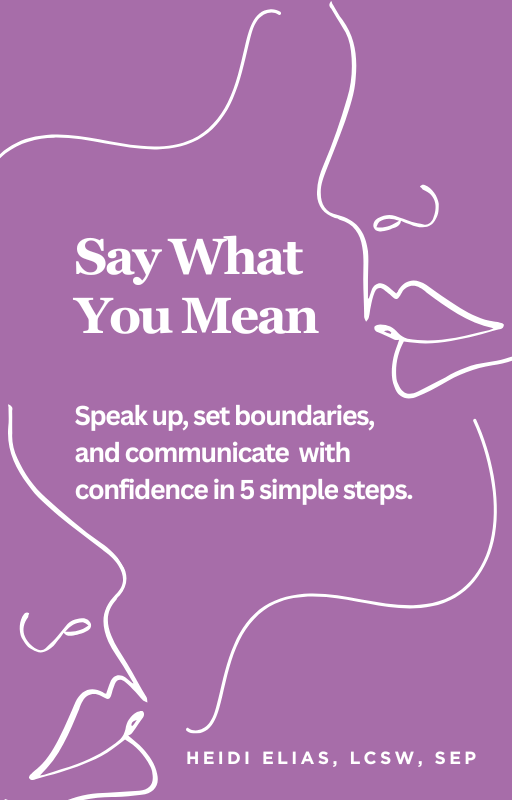
Get the free “Say What You Mean” guide and learn a simple 5-step approach to communicating clearly and confidently.
This resource will help you identify unhelpful communication habits, turn vague questions into clear statements, and express your needs with greater confidence, especially during difficult conversations.
With practice, these skills can strengthen boundaries, reduce anxiety, and help you feel more grounded in your relationships.
Want to learn how to communicate clearly and confidently?
Communication skills can be learned. In therapy, you’ll gain practical tools to express yourself more clearly, set healthy boundaries, and speak up with greater confidence.
Let’s discuss how I can help you get there.